The Forty Servants (used with permission) was created by Tommie Kelly.
Click each card's link for meanings, or pick up one of his books to learn more.
Atom Bomb Tarot (used with permission) was created by bluefluke.
// ○
Quick Start
Choose a [Deck], click [Draw 1] to card, drag them wherever you want them.
Two finger touch or mouse the rotate icon to rotate
// ○
Table of Contents
// ○
The Trinary Approach
Transparency
Nothing about the process Trinary uses to deal cards is a secret; it's happily explained, so you don't have to wonder what's actually happening behind the scenes.
For randomness, Trinary uses the Mersenne Twister ↗︎ pseudorandom number generator. It's seeded using the current time, a high-resolution timer (and where applicable, your statement of intent) combined.
That controls the regular [Shuffle] button.
If you don't like code shuffling your cards and you prefer to use your own hand to shuffle, we offer that too (see below).
Authenticity
Wherever possible I try to preserve the experience of reading cards and make the online process as close to the offline process as I can.
A tool, not a replacement.
The cards you are using and the order they are in is carefully preserved throughout the process, until you hit the [Clear] button to start over. It has been since it was first added in Trinary v2.
That means when you hit [Shuffle] more than once, it's not just starting over. The second [Shuffle] takes the result of the first one, and shuffles THAT. The third time you shuffle, you're shuffling the result of the second. And so on. This preserves the readers ability to keep shuffling till it "feels right". Then when you stop shuffling, the order of the cards is predetermined as you deal them out. They are in the order you shuffled them into, like a real deck.
This idea of continued shuffling till it "feels right" (just like offline), was so important to me that in Trinary v2 I started each deck in order, so you HAD to shuffle. But I was told that was annoying and so now they begin shuffled and you can order them with the [Sort] button if you want.
You also have a [Manual Shuffle], so you can do it yourself instead of letting Trinary. This gives you squares to click on, representing face-down cards that you are stacking in whatever order you click. This allows you to fully determine the order of the cards with your own hand.
I also added [Cut Deck], which acts on the stack of cards you shuffled just like a regular cut would in real life. You reach down as far as you want till it "feels right", and that's where the cut happens to your stack that we're been keeping in your shuffled order the whole time.
And just like a real deck, you can [Peek] and see what order your cards are in. This also allows you to verify how I described [Cut Deck] works, if you [Peek] before and after a cut.
You can shuffle and cut at any point, like you would offline. So for example, you could get a query, concentrate on the query while you shuffle, deal the response; then if they ask a follow up question you can shuffle or cut the remaining cards that are still in your deck while concentrating on this new question, before dealing again.
You can switch decks in the middle of a reading if you wanna get crazy and deal from more than one deck at a time. And, importantly, each deck is handled separately as you switch from one deck to another. So you can have reversals on for one deck and not the other, or shuffle one deck and not the other.
Privacy
Your tarot reading is always private!
(We never save, store, or read them).
If we add the ability to save memorable spreads in the future, you'll know you're doing it, you'll be choosing to do it. Nothing sneaky.
// ○
Methods & Options
There's a variety of Tarot, oracle, and runes to choose from here.
- Rider Waite Smith
-
The is the most popular and widely used tarot deck in existence.
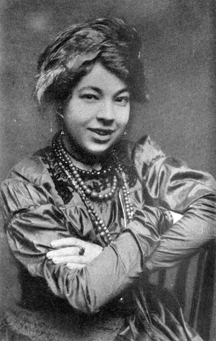
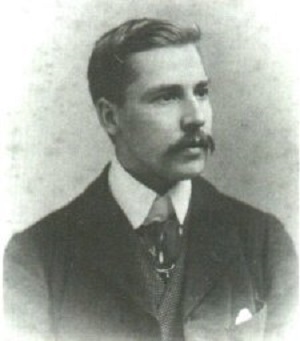
It was created by conceptualized by A.E. Waite and illustrated by Pamela Coleman Smith, both members of The Hermetic Order of the Golden Dawn, and published by The Rider Company in 1909.
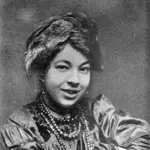
Pamela Coleman Smith 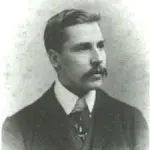
A.E. Waite The symbolism on the cards was influenced by the work of Eliphas Levi, and the teachings of the Golden Dawn. Waite switched the order of Strength and Justice to fit the astrological correspondence taught in the Golden Dawn, as well as several other innovations.
One of the most noticable is the fully illustrated minor arcane, where many previous tarot decks only had pips on their minors.
There is a companion booklet author by Waite called The Key to the Tarot, and a layer revised version called The Pictorial Key to the Tarot.
- Thoth
-
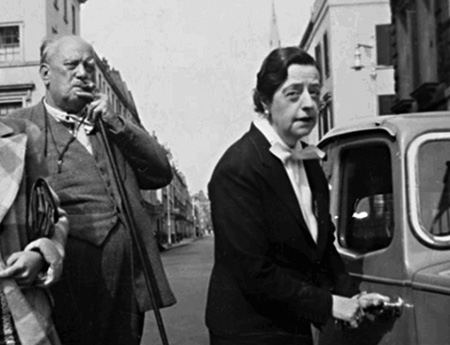
The Thoth Tarot was conceptualized by Aleister Crowley and painted by Lady Frieda Harris between 1938 and 1943.
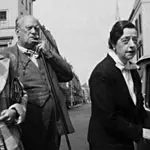
Aleister Crowley and Lady Frieda Harris Crowley referred to the deck as The Book Of Thoth and in 1944 wrote a book of the same title about the deck.
Crowley incorporated symbolism from a variety of sources, named each card, adjusted their numerical, astrological, and Hebrew correspondences.
The court cards use the Golden Dawn's arrangement of Knight, Queen, Prince, Princess instead of the now common Kind, Queen, Knight, Page.
- Tarot de Marseille
- A standard pattern of Italian-suited tarot, popular in France in the 17th-18th centuries. This was the deck that originally made the leap from game to occult.
- Atom Bomb (RWS or Thoth)
- [Used with permission]
-
The Atom Bomb Tarot was created by the artist known as Bluefluke, who is author of the popular free occult resource The Psychonaut Field Manual. You can get a copy of The Atom Bomb Tarot here.
Besides his own unique artwork, each card features various useful correspondences. He drew the cards in such a way that a deck can be customized to fit the pattern of a Rider-Waite-Smith deck or a Thoth deck to suit the preference of the owner.
Future chapters of the Psychonaut's Field Guide are expected to deliver further into the details of The Atom Bomb Tarot, and tarot itself, as a key to unlocking and understanding all magical practices.
- Petit Lenormand
- Johann Kaspar Hechtel, created "Das Spiel der Hoffnung" (The Game of Hope) in 1799.
- Marie Anne Lenormand was a very famous french fortune-teller who read for many prominent figures of the time.
- After Lenormand's death in 1843, publishers began selling fortune-telling cards bearing her name, including decks based on Hechtel's "The Game of Hope". They became a unique cartomancy practice.
- Forty Servants
- [Used with permission]
-
The Forty Servants is an oracle deck created by the modern magician Tommie Kelly who can be found in his website Adventures in Woo Woo. You can pick up a physical copy here.
Besides divination the cards can also be used as servitors (or something more if you wish), with the characters on each card having their own unique spheres of influence like a pantheon.
There are a couple companion books for it, The Forty Servants - Little Black Book and The Grimoire of The Forty Servants: The Complete Guide to the Magick and Divination System, if you want more in depth information.
If you like The Forty Servants you may want to check out Tommie's other work on his website or vlog.
- Lotería
-
A traditional Mexican game of chance similar to bingo but using cards and verses. It is sometimes referred to as "Mexican Bingo".
Lotería's origins date back to fifteenth century Italy and it was bright to Mexico in 1769. Don Clemente Jacques' iconic deck was published in 1887.
As with tarot before it, the cards from this popular mainstream game are now used for occult divination.
- Playing Cards
-
Modern playing cards and tarot cards both evolved from a common deck of playing cards that originated in the 14th century in Europe.
Some occultists perform divination (cartomancy) with a standard set of playing cards.
A deck typically has 4 suits that each that go from 1(ace) to 10, then Jack, Queen, King. Optionally there may be 2 Jokers.
- Zener Cards
-
Zener cards are cards used to conduct experiments for extrasensory perception (ESP). For example you can practice trying to predict which card you will draw next, or you can look at a card your partner cannot see and try to communicate it telepathically to them.
Perceptual psychologist Karl Zener (1903–1964) designed the cards in the early 1930s for experiments conducted with his colleague, parapsychologist J. B. Rhine (1895–1980).
They are sometimes depicted in color, and sometimes only in black and white.
-
You can even subvert their originally intended use and do readings with them if you wanted. I like to use them for elemental readings:
- Star = Spirit
- Circle = Air
- Cross = Fire
- Square = Earth
- Waves = Water
- Elder Futhark
-
The oldest runic alphabet (not to be confused with the oldest alphabet period), used by the Germanic people in the first to eighth centuries.
Besides each rune having its own sounds, they also have associated meanings, which make them perfect for use in divination in which runes will typically be inscribed on small stones and drawn at random to have their meanings analyzed.
They can also be used in accordance with their meanings in a sigil or any number of other magical workings.
// ○
Background & Practice
Reading cards for divination was a thing as early as around 1450 according to Fernando de la Torre. Tarot appeared in Italy a little later as a game. Shortly after, people started using it for divination as well. Ya can't stop the signal.
One piece of misinformation that some movies (and some churches) get wrong is thinking that the cards themselves are magical. Most occultists believe the magic actually comes from the discernment, intuition, and knowledge of the person interpreting them. If I'm wrong tho, where can I apply for the job at the card factory where I get to enchant them on the assembly line?
There are countless different tarot, oracle, and "other" decks used for divination and I can't give you the full history of the practice but it's an interesting thing humans have done for a long time and we're always finding and making new ways to do it.
// ○
Complete Guide: Tarot Cards etc.
- Basics
-
- Choose a deck.
- Shuffle (and optionally cut) while thinking of your question.
- Draw a card and drag it where you want it.
- Keep using as many cards as you want/need.
- [You can switch decks at any time, using more than one in the same reading]
- Deck
- Choose a deck, this button will also show the number of cards left as you begin to deal them.
- Draw 1
- Draws one card from the top of the deck.
- Reversals
- Determines whether or not you'd like some cards to be upside-down.
- To set this on a deck by deck basis just switch to the deck and choose to use reversals or not. In this way you can, for example, deal Rider Waite Smith cards with reversals, and runes without, onto the same table.
- Clear
- Returns all cards from the table back into the deck.
- Jokers
- Whether or not to include jokers in the deck.
- [Only available with Playing Cards]
- Color
- Toggle between color and black-and-white.
- [Only available with Zener Cards]
- Blank
- Toggles whether or not to include a blank rune.
- [Only available with Elder Futhark runes]
- Shuffle
- Shuffles your deck. It's recommended to shuffle many times while thinking about your question.
- [Trinary tracks the position of every card as you shuffle, just like a physical deck]
- [Shuffling is handled on a deck-by-deck basis. So if you switch decks shuffle the new deck too.]
- Manual Shuffle
- Instead of letting the code shuffle your cards you can manually do it if you'd like to be more a part of the order they end up in. Just click the squares, it's like picking up cards from a pile to form your deck.
- [Clicking a square will place that card on top of your already randomized deck. So for example, if you are only going to a 3 card spread, you can stop after clicking 3 squares]
- [Trinary tracks the position of every card as you shuffle, just like a physical deck]
- [Shuffling is handled on a deck-by-deck basis. So if you switch decks shuffle the new deck too.]
- Cut Deck
- If you'd like to cut the deck just drag the slider how far down you'd like to cut.
- [Trinary tracks the position of every card as you shuffle, just like a physical deck]
- Peek
- Just like a real deck, you can look at the order your cards ended up in if you want to.
- [Trinary tracks the position of every card as you shuffle, just like a physical deck]
- Meanings
- Toggles on and off the link to each cards meaning.
- [Not all decks have these yet]
- Handles
- Toggle on or off the rotation handles on each card.
- [These are for a mouse, on a touch-screen you can two finger drag to rotate.]
- Card Size
- Change the size of the cards.
- Table
- Give you choices of background images.
- Width
- Adjusts the width of the card table.
- Height
- Adjusts the height of the card table.
- Expand
- Gives you the option to either require scrolling, or show the entire table at once so you can zoom out and view it all.
- Sort
- Puts all your cards back in order. Basically unshuffles them.
// ○
- Rider Waite Smith
- Thoth
- Tarot de Marseille
- Atom Bomb RWS
- Atom Bomb Thoth
- Petit Lenormand
- Forty Servants
- Lotería
- Playing Cards
- Zener Cards
- Elder Futhark
© 2015-2026 ChaosTarot.com | Privacy Policy | Terms of Use